“The goal is to turn data into information, and information into insight.” — Carly Fiorina, former CEO of Hewlett-Packard
There was a time — not long ago — when simply having data was enough to win. Companies raced to build data lakes, hired armies of engineers to pipe information from every touchpoint, and patted themselves on the back for the sheer volume of it all. Terabytes became petabytes. Dashboards multiplied. Storage costs dropped.
And yet, for most organizations, nothing fundamentally changed.
Sales teams still made gut calls. Leadership still debated the same strategy questions. And somewhere in a data warehouse nobody had time to query, the answers were sitting there, quietly collecting dust.
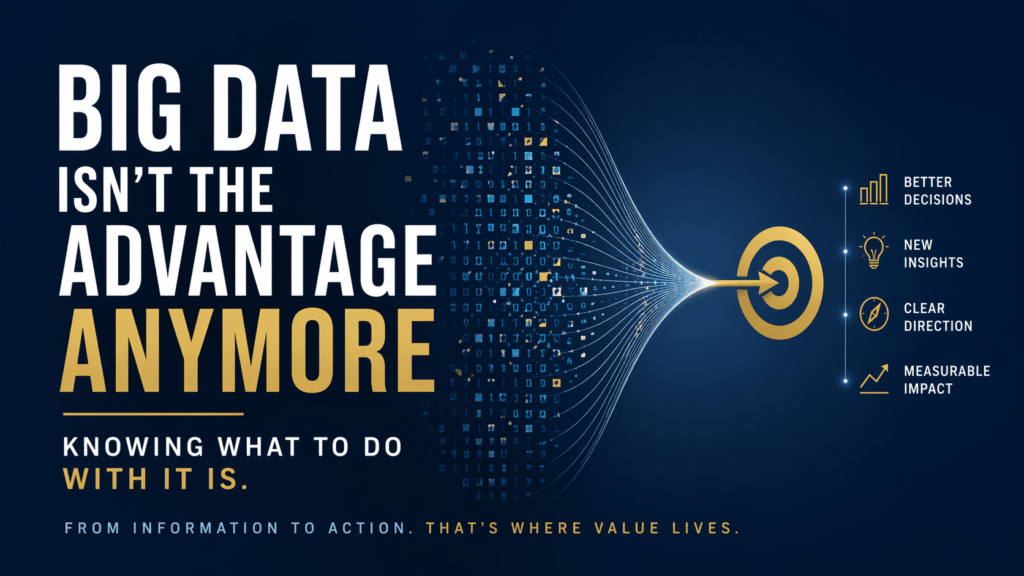
Here’s the uncomfortable truth that the industry is finally starting to reckon with: the data collection race is over, and almost everyone has won — which means no one has. The real competition has moved elsewhere. It’s moved into the organizational capability to act on data, strategically and at speed.
This is what separates the companies pulling ahead from the ones still admiring their infrastructure.
The Illusion of the Data Advantage
Let’s start with a myth worth dismantling: the idea that more data automatically confers competitive advantage.
For a brief window in the early 2010s, it did. The companies that figured out how to collect behavioral data at scale — your Googles, Facebooks, Amazons — built genuine moats around their data assets. But that window has effectively closed for most industries.
Here’s why:
- Data infrastructure has commoditized. AWS, Google Cloud, Azure, and Snowflake have made enterprise-grade data architecture accessible to companies of every size. The stack that would have cost millions to build a decade ago is now a subscription.
- Regulatory floors have leveled the playing field. GDPR, CCPA, and their global equivalents have placed limits on the type of data companies can collect, narrowing the advantage gap between large and small players.
- Third-party data is eroding. The deprecation of third-party cookies, app tracking restrictions, and increasing consumer privacy awareness have squeezed the richest external data channels.
- Your competitors have the same vendors you do. If you’re using Salesforce, HubSpot, Google Analytics, or any of the dominant platforms, you’re generating structurally similar data to every other company in your sector.
The result? Data parity. Not perfect parity — but parity enough that raw volume is no longer the differentiator it once was.
So What Is the New Differentiator?
If the data itself isn’t the moat, the moat must be built from something else. And that something else is analytical capability — the organizational competency to extract, interpret, and act on signal faster and more accurately than your competition.
This breaks down into three interconnected layers:
1. The Technical Layer — From Storage to Decision
Most companies have mastered storing data. Far fewer have mastered the pipeline from raw data to executable decision. The technical layer isn’t just about having a data warehouse; it’s about the quality of the architecture that connects data to the people and systems that need to act on it.
Questions worth asking:
- How long does it take from an event occurring in the real world to that event being visible in your analytics?
- Can your data scientists deploy a model into production, or does every model require a six-month engineering project?
- Are your dashboards answering questions your teams actually have, or answering questions that were relevant two years ago?
2. The Human Layer — Literacy Across the Organization
This is where most organizations hit their ceiling. You can have world-class infrastructure and a brilliant data science team, but if the people making decisions — your managers, directors, VPs — can’t engage with data fluently, the pipeline breaks at the final mile.
Data literacy is no longer a “nice to have” for analytical roles. It is a baseline requirement for organizational leadership.
Companies that are pulling ahead invest aggressively in building this literacy — not just through training programs, but by redesigning how data is presented and embedded into workflows, so that engagement with insight becomes the path of least resistance, not an extra step.
3. The Cultural Layer — Permission to Act
This may be the most underrated dimension of all. Even organizations with excellent technical infrastructure and reasonably literate teams can stall if the culture around data is wrong.
Two common failure modes:
HiPPO syndrome — the Highest Paid Person’s Opinion wins regardless of what the data says. Data becomes political cover for decisions already made, not the foundation for decisions yet to be made.
Analysis paralysis — the organization demands more data, more certainty, more validation before acting, until the window of opportunity has closed. Ironically, this is often a symptom of too much data, not too little — teams drown in complexity and default to inaction.
The cultural fix requires leadership modeling: leaders who openly cite data in their reasoning, who push back on gut-based assertions with evidence, and who create psychological safety for data-driven recommendations to challenge existing assumptions.
A Framework for Building Analytical Capability
Based on patterns observable across high-performing analytical organizations, maturity typically evolves across four stages. Understanding where your organization sits is the first step toward knowing where to invest.
| Stage | Description | Primary Bottleneck | Typical Outcome |
|---|---|---|---|
| Stage 1: Reactive | Data is pulled ad hoc to justify decisions already made | Access and tooling | Reporting, not insight |
| Stage 2: Descriptive | Regular reporting on what happened | Speed and consistency | Backward-looking intelligence |
| Stage 3: Predictive | Models and analysis forecasting what will happen | Talent and trust | Forward-looking decisions |
| Stage 4: Prescriptive | Systems recommend or automate optimal actions | Culture and integration | Competitive differentiation |
Most mid-market organizations sit somewhere between Stage 1 and Stage 2. The leap to Stage 3 requires a combination of talent investment and cultural permission. Stage 4 — where data capability becomes a genuine strategic weapon — requires all three layers working in concert.
The Real Cost of Analytical Immaturity
It’s tempting to frame the investment in analytical capability as an abstract strategic priority. But the cost of not building this capability is concrete and compounding.
Consider what analytical immaturity costs at each level of the organization:
At the executive level:
- Strategic decisions made on intuition when contradicting data exists
- Delayed detection of market shifts that competitors catch earlier
- Capital allocation based on lagging indicators
At the operational level:
- Inefficient resource allocation (people, budget, inventory) based on rules-of-thumb rather than demand signals
- Customer churn that was predictable but unprevented
- Pricing left on the table due to underdeveloped segmentation
At the team level:
- Hours spent building manual reports that should be automated
- Conflicting metrics creating inter-departmental friction (“Which number is right?”)
- Good analysts burning out and leaving when their work generates no action
The cost is not just efficiency — it is strategic drift. Organizations that cannot act on data are increasingly making decisions in the dark while their more analytically mature competitors navigate by a much clearer map.
Five Signs Your Organization Has Outgrown Its Analytical Approach
How do you know whether your current approach to data is holding you back? Here are five diagnostic signals worth examining honestly:
- Your data team spends more time pulling reports than generating insights. If analysts are primarily in the business of answering the same recurring data requests, the infrastructure is serving the wrong master.
- Every cross-functional meeting features a debate about which numbers are correct. Data inconsistency is a sign of missing governance — and a significant drag on decision speed.
- Your most important decisions are still made by the most senior person in the room. Seniority is not a substitute for evidence. If hierarchy routinely overrides data, you have a culture problem dressed as a leadership style.
- Your models exist but aren’t used. If your data science team has built predictive models that are rarely or inconsistently integrated into decisions, the bottleneck is almost certainly integration and trust, not model quality.
- You know what happened last quarter, but you can’t predict what will happen next quarter. Descriptive analytics is table stakes. If your capability stops at historical reporting, you’re operating with one eye closed.
What Strategic Analytical Capability Actually Looks Like in Practice
Theory is useful. But let’s make this concrete. Here are three illustrative examples of what it looks like when analytical capability becomes a genuine competitive advantage:
🔹 Dynamic Pricing That Responds to Reality
Rather than setting prices quarterly based on historical cost structures, analytically mature organizations model demand signals in near-real-time — adjusting pricing based on competitor behavior, inventory levels, and customer segment dynamics. The data isn’t new; the capability to act on it quickly and systematically is.
🔹 Churn Prediction That Actually Prevents Churn
Identifying at-risk customers is only valuable if the insight triggers a timely, relevant intervention. Organizations that close the loop — from prediction to automated or human-assisted outreach — convert an analytical insight into a revenue outcome. Most organizations can predict churn. Far fewer have built the operational bridge to prevent it.
🔹 Resource Allocation That Responds to Evidence
Whether it’s marketing budget, hiring, or inventory, the most analytically capable organizations run ongoing experiments — testing, measuring, and reallocating based on evidence rather than annual planning cycles. The planning cycle is replaced by a continuous learning loop.
Where to Begin: A Practical Roadmap
If you’re reading this and recognizing gaps in your own organization’s analytical maturity, the instinct may be to reach for another platform, another tool, another vendor pitch. Resist that instinct.
The highest-leverage investments in analytical capability are almost never technical.
Here’s where to start:
→ Audit your decision-making process, not your data. Map the ten most consequential decisions your organization makes regularly. For each one, identify what data could inform it, what data currently does inform it, and what the gap is. That gap is your real roadmap.
→ Build for trust before you build for sophistication. If people don’t trust the data they have, they won’t use more sophisticated analyses even when they’re available. Invest in data quality, consistent definitions, and transparent methodology before building the next predictive model.
→ Measure the use of insight, not just the production of insight. Most analytics teams measure outputs: dashboards built, reports delivered, models trained. Start measuring downstream outcomes: decisions influenced, actions triggered, revenue attributed. This reorients the team from production to impact.
→ Make data the path of least resistance. The best analytical capability is one that people engage with because it’s the easiest way to answer the question they already have — not one they have to seek out, learn, or advocate for.
→ Treat analytical culture as a leadership behavior, not an HR program. The highest-ROI action any executive can take is to consistently and visibly use data in their own decision-making. Culture is downstream of behavior.
Closing Thought
The companies that will define the next decade of competition in virtually every sector are not the ones sitting on the largest data sets. They are the ones that have built the organizational muscle to do something with it — quickly, consistently, and strategically.
The data era has matured. We’ve moved past the gold rush of collection and into the harder, more human work of comprehension and action.
The question is no longer do you have the data.
The question is: what are you doing with it?
Dr. Roman Antonov works at the intersection of strategy, technology, and organizational transformation. If this post resonated with you, explore more insights at drromanantonov.com.
Tags: Big Data, Analytics Strategy, Data-Driven Decision Making, Business Intelligence, Organizational Capability, Digital Transformation