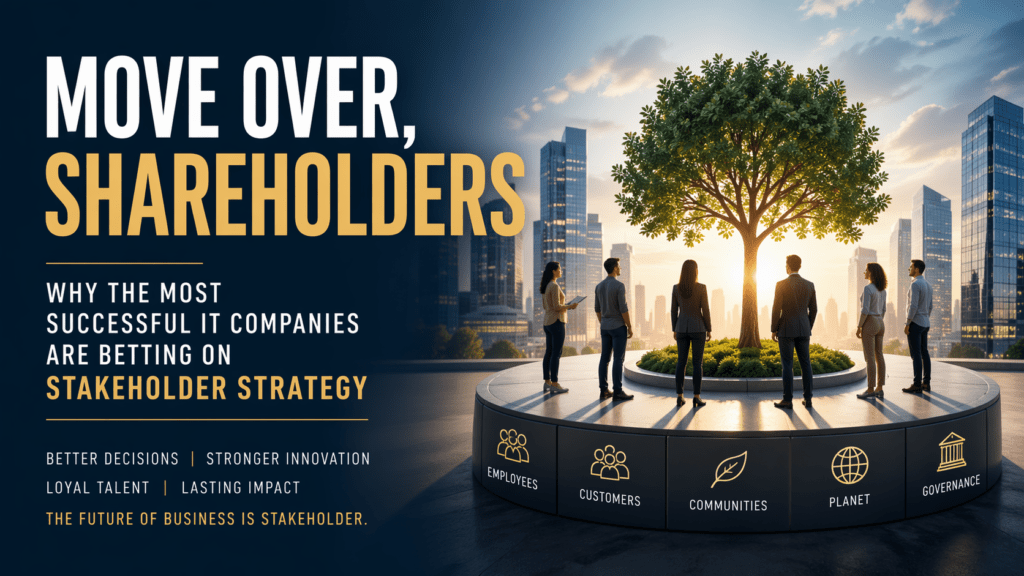
“The purpose of a corporation is no longer just to generate profit for its shareholders. It is to create value for all its stakeholders — customers, employees, suppliers, communities, and yes, shareholders too.” — Business Roundtable, 2019 Statement on the Purpose of a Corporation
For most of the 20th century, one idea dominated the boardrooms of the world’s most powerful companies: maximize shareholder value. The logic was seductive in its simplicity. Companies exist to generate profit. Shareholders own the company. Therefore, every strategic decision should serve the shareholder first, last, and always.
Milton Friedman made this doctrine famous in 1970, and for decades it was treated as gospel.
Then something started to crack.
The dot-com collapse. The 2008 financial crisis. The reputational implosions of once-untouchable corporations. A global workforce demanding meaning alongside a paycheck. Customers who researched, reviewed, and rejected companies based on values — not just price. Regulators stepping in with Environmental, Social, and Governance (ESG) mandates. One by one, the pillars of the shareholder-first world began to show their age.
And in the ruins of that old model, the most forward-thinking IT companies in the world quietly started building something new.
They were building a stakeholder strategy.
The Old Playbook: What Shareholder Primacy Actually Meant
Before we explore the shift, it’s worth being precise about what we’re moving away from. Shareholder primacy is not simply “caring about profit.” It is a specific doctrine that asserts:
- Every major decision should be evaluated primarily through the lens of shareholder return.
- Short-term stock performance is a legitimate and dominant measure of corporate health.
- External costs — to communities, employees, the environment — are acceptable if they improve the bottom line and remain legal.
- The board’s fiduciary duty runs almost exclusively to investors.
For technology companies in particular, this model created serious tensions. Software products are built by people — talented, values-driven, highly mobile people who can work almost anywhere. IT companies also depend on massive ecosystems of partners, developers, and platform users whose goodwill is not guaranteed. And they operate in a regulatory environment that grows more demanding with each passing year.
In short, the shareholder-only playbook was a poor fit for a knowledge economy long before most executives admitted it.
What Is Stakeholder Strategy, Really?
Stakeholder strategy is not corporate charity. Let’s be very clear about that.
It is a governance model that recognizes a broader set of parties whose engagement, trust, and satisfaction are materially linked to long-term enterprise value.
The core stakeholder groups for an IT company typically include:
| Stakeholder Group | What They Contribute | What They Expect in Return |
|---|---|---|
| Shareholders / Investors | Capital, financial credibility | Sustainable returns, transparent governance |
| Employees | Innovation, execution, culture | Fair compensation, growth, purpose |
| Customers | Revenue, market validation | Value, reliability, ethical practices |
| Partners & Suppliers | Ecosystem strength, speed | Fair terms, long-term relationships |
| Communities | Social license to operate | Positive local impact, accountability |
| Regulators & Governments | Legal operating environment | Compliance, transparency, cooperation |
| Environment | Operational continuity | Reduced footprint, responsible use |
The critical insight is this: each of these groups holds a form of power over the company’s competitiveness. Ignore employees — and you lose innovation. Alienate customers — and you lose revenue. Exploit communities — and you invite regulatory backlash. Neglect partners — and your ecosystem fragments.
Shareholder primacy treats these relationships as constraints. Stakeholder strategy treats them as strategic assets.
The Tipping Point: A Global Shift in Corporate Governance
The movement toward stakeholder-inclusive governance is not a trend confined to progressive startups or Scandinavian companies. It represents a fundamental restructuring of how the world’s most powerful institutions define corporate purpose.
Consider the following milestones:
📌 2019 — Business Roundtable Redefines the Purpose of a Corporation In a landmark declaration signed by nearly 200 CEOs of America’s largest companies — including those from Amazon, Apple, and JPMorgan Chase — the Business Roundtable explicitly abandoned the doctrine of shareholder primacy. The statement committed signatories to deliver value to all stakeholders.
📌 2021 — SEC Mandates ESG Disclosure Frameworks The U.S. Securities and Exchange Commission began pushing for standardized climate and social risk disclosures, signaling that stakeholder impact is now a material financial concern, not a PR nicety.
📌 2022–2024 — EU Corporate Sustainability Reporting Directive (CSRD) Europe went further, requiring thousands of companies — including non-EU firms operating in Europe — to report on their impact across environmental, social, and governance dimensions. Stakeholder accountability is now law across much of the developed world.
📌 2024–2025 — Rise of Long-Term Shareholder Activism Institutional investors like BlackRock, Vanguard, and State Street — collectively managing trillions in assets — began voting against boards that failed to demonstrate stakeholder accountability. The signal was unmistakable: long-term shareholders now want stakeholder governance.
This is not idealism. This is market logic.
Case Study #1 — Microsoft: From Cutthroat to Community-Centered
There may be no more striking corporate transformation of the past decade than Microsoft under Satya Nadella.
When Nadella became CEO in 2014, Microsoft was widely described as a company in decline — internally fractured by stack ranking performance systems that pitted employees against each other, and externally known for aggressive, monopolistic behavior toward partners and competitors alike.
The turnaround Nadella engineered was, at its core, a stakeholder transformation.
What changed internally:
- Stack ranking was eliminated. Employees were evaluated on collaboration and shared growth, not individual dominance.
- A culture of “learn-it-all” replaced the old “know-it-all” ethos — directly improving employee engagement and innovation output.
- Investment in LinkedIn (2016) and GitHub (2018) extended Microsoft’s reach into developer and professional communities, creating stakeholder ecosystems rather than just product markets.
What changed externally:
- Microsoft made dramatic commitments on carbon negativity — pledging to remove all the carbon it has ever emitted by 2050.
- The company invested billions in AI ethics and responsible AI frameworks, engaging regulators and civil society proactively rather than reactively.
- Its Azure partner ecosystem became one of the most expansive in enterprise tech, built on a philosophy of partner first, compete second.
The result?
Microsoft’s market capitalization grew from approximately $300 billion in 2014 to regularly exceeding $3 trillion by 2024 — making it one of the most valuable companies in human history. The stock price did not suffer from stakeholder investment. It was driven by it.
The lesson from Microsoft is profound: when you invest in your employees’ growth, your partners’ success, your communities’ trust, and your customers’ outcomes — shareholders benefit more, not less.
Case Study #2 — Salesforce: Building Business on “Ohana”
Salesforce is a company that has worn its stakeholder philosophy on its sleeve since its founding. CEO Marc Benioff coined the term “Ohana” — the Hawaiian concept of chosen family — to describe how Salesforce approaches its relationships with employees, customers, partners, and communities.
But make no mistake: this is a strategic framework, not just a cultural slogan.
How Salesforce operationalizes stakeholder strategy:
- 1-1-1 Model: From its earliest days, Salesforce pledged 1% of its equity, 1% of its products, and 1% of its employees’ time to philanthropic causes. This was not a gesture — it seeded the Salesforce.org foundation and inspired hundreds of other companies to adopt similar frameworks.
- Employee Equality: Salesforce has conducted multiple company-wide pay equity audits and spent tens of millions correcting gender and racial pay gaps — before being legally required to do so.
- Customer Success as Identity: Salesforce pioneered the role of Chief Customer Officer and built entire business units around customer success outcomes, not just product adoption. Customer retention and expansion became board-level metrics alongside revenue.
- Ecosystem Commerce: The Salesforce AppExchange is one of the most robust partner ecosystems in enterprise software. Salesforce actively invests in the success of ISVs and implementation partners, recognizing that a thriving ecosystem multiplies its own value.
The financial reality?
Salesforce grew from roughly $1 billion in revenue in 2009 to over $34 billion in FY2024. Its trajectory is inextricably linked to the strength of the relationships it cultivated across its stakeholder network.
Case Study #3 — SAP: Stakeholders as the Engine of Enterprise Relevance
SAP, the German enterprise software giant, offers perhaps the most explicit example of a company consciously adopting stakeholder governance as corporate doctrine.
Under CEO Christian Klein, SAP restructured its entire strategic framework around what it calls the “Business Beyond Bias” and “RISE with SAP” philosophy — centering not just on product delivery, but on enabling customers to achieve their stakeholder goals.
Key pillars of SAP’s stakeholder approach:
- Integrated Reporting — SAP was among the first enterprise tech companies to publish fully integrated financial and non-financial reports, treating environmental and social performance as material business data, not supplementary disclosures.
- Employee Net Promoter Score (eNPS) as a KPI — SAP tracks employee satisfaction with the same rigor as revenue, tying leadership compensation directly to people metrics.
- Customer Value Realization — SAP’s professional services model shifted from billing for implementation hours to ensuring customers achieved measurable ROI from their SAP investments — a stakeholder-first reframing of the professional services business model.
- Supplier Diversity Programs — SAP actively curates and reports on the diversity of its supplier base, extending stakeholder accountability into its supply chain.
- Social Sabbatical — SAP sends employees on paid social sabbaticals to work with NGOs and nonprofits, returning them with broader perspective and deeper purpose — a direct investment in employee stakeholder value.
Why does this matter competitively?
SAP’s stakeholder strategy has helped it retain relevance in a market increasingly crowded with cloud-native challengers. Enterprise clients — who are themselves under mounting ESG pressure — prefer vendors with credible stakeholder practices. In B2B enterprise tech, stakeholder alignment has become a competitive differentiator in RFPs and vendor selection processes.
Shareholder vs. Stakeholder Strategy: A Direct Comparison
| Dimension | Shareholder-First Model | Stakeholder Strategy Model |
|---|---|---|
| Primary Goal | Maximize shareholder return | Create sustainable value for all stakeholders |
| Time Horizon | Short to medium term (quarterly) | Long-term and perpetual |
| Employee Approach | Cost to be managed | Asset to be invested in |
| Customer Relationship | Transactional | Partnership-oriented |
| Community Role | External constraint | License to operate |
| Risk Management | Financial risk focus | Reputational, regulatory, relational risk |
| Innovation Source | Internal R&D budget | Ecosystem co-creation |
| Leadership Incentives | Stock price, EPS | Balanced scorecard incl. people & planet |
| Regulatory Stance | Reactive compliance | Proactive engagement |
| Competitive Advantage | Product/price | Trust, ecosystem, brand, talent |
Why This Model Is Especially Powerful in IT
Every industry has stakeholders. But the IT sector has a unique relationship with stakeholder dynamics that makes this model particularly potent — and particularly urgent.
Here’s why:
1. Talent Is the Product
In manufacturing, you can often separate the workforce from the output. In IT, the people are the competitive advantage. The code, the architecture, the innovation — it all lives in people’s heads. An IT company that fails its employee stakeholders is not just losing workers; it is losing its product pipeline.
2. Platform Economics Magnify Every Relationship
IT companies live or die by their ecosystems. A developer ecosystem (like GitHub), a partner ecosystem (like Azure Marketplace), or a customer community (like Salesforce Trailhead) can be worth more than any single product line. These ecosystems are stakeholder communities with enormous economic leverage.
3. Trust Is a Technical Requirement
In an era of data breaches, algorithmic bias, and AI-driven decision-making, customers don’t just want reliable software — they want trustworthy software. And trust is earned not through legal compliance but through demonstrated, consistent commitment to stakeholder interests.
4. Regulatory Pressure Is Accelerating
GDPR, AI Act, CSRD, Digital Services Act — the regulatory environment around IT has become extraordinarily complex. Companies with established stakeholder relationships with regulators and policymakers navigate this landscape with dramatically lower friction than those operating in adversarial postures.
The Competitiveness Equation
Drawing on my research in IT Enterprise Competitiveness Management, I want to offer a conceptual framework that ties these threads together:
Sustainable IT Competitiveness = (Product Excellence × Stakeholder Trust) / Systemic Risk
This is not a mathematical formula — it is a strategic lens.
- Product Excellence remains essential. No stakeholder strategy compensates for inferior software.
- Stakeholder Trust multiplies competitive advantage by creating resilient ecosystems, talent pipelines, regulatory goodwill, and customer loyalty that competitors cannot easily replicate.
- Systemic Risk — reputational, regulatory, relational — acts as a denominator that can rapidly erode even significant competitive positions when stakeholder relationships are neglected.
Microsoft, Salesforce, and SAP are not charitable organizations. They are fiercely competitive businesses that discovered — some through crisis, some through vision — that stakeholder investment is the most durable form of competitive moat available to a knowledge-economy enterprise.
A Note to Business Leaders Reading This
If you are leading an IT company — or aspiring to — and you are still framing your strategic choices primarily around the next earnings call, I offer this observation with full respect:
You may be optimizing for the wrong variable.
The companies defining the next decade of enterprise technology are not doing so by extracting maximum value from their relationships. They are doing so by generating value across them. The market is beginning to price this understanding into valuations, talent flows, and enterprise purchasing decisions.
The question is not whether to adopt a stakeholder strategy. The question is whether you will do so proactively — and gain the first-mover advantages that Microsoft, Salesforce, and SAP have already demonstrated — or reactively, once the gap has grown too wide to close.
The choice, as always, belongs to leadership.
Key Takeaways
- ✅ Shareholder primacy is structurally misaligned with the competitive dynamics of the modern IT industry.
- ✅ Stakeholder strategy is not philanthropy — it is a sophisticated governance model linking relational capital to long-term enterprise value.
- ✅ Microsoft, Salesforce, and SAP demonstrate that stakeholder investment delivers superior competitive outcomes over any meaningful time horizon.
- ✅ Regulatory, talent, and customer market forces are all converging to make stakeholder governance the new baseline expectation, not a differentiator.
- ✅ IT companies are especially positioned to benefit from stakeholder strategy given their platform economics, talent dependency, and trust-based business models.
- ✅ Leaders who act now capture ecosystem, brand, and talent advantages that compound over time and become increasingly difficult for competitors to replicate.
Further Reading & Research
This blog post connects to my broader body of research on IT Enterprise Competitiveness Management, including published work on the transformation of governance models in technology-driven markets. I invite you to explore my Research page for peer-reviewed publications, and to reach out through my Contact page if you’d like to discuss how these frameworks apply to your organization’s strategy.
The conversation about corporate purpose is the most important strategic conversation of our time. I look forward to having it with you.
Dr. Roman Antonov is a Doctor of Economics, MBA, PMP, and Six Sigma Black Belt with 11 years of experience in IT enterprise competitiveness management. His research focuses on transformational change in IT enterprises, governance models, and sustainable competitive advantage in digital markets.
Tags: #StakeholderStrategy #CorporateGovernance #ITLeadership #Microsoft #Salesforce #SAP #ESG #BusinessStrategy #TechLeadership #CompetitivenessManagement