“The companies that will thrive in the next decade are not just those that build the best products — they’re the ones that build them responsibly.”
There was a time when “going green” was little more than a PR checkbox. A recycling bin in the break room. A sustainability page buried deep in an annual report. A feel-good initiative with no real teeth.
That time is over.
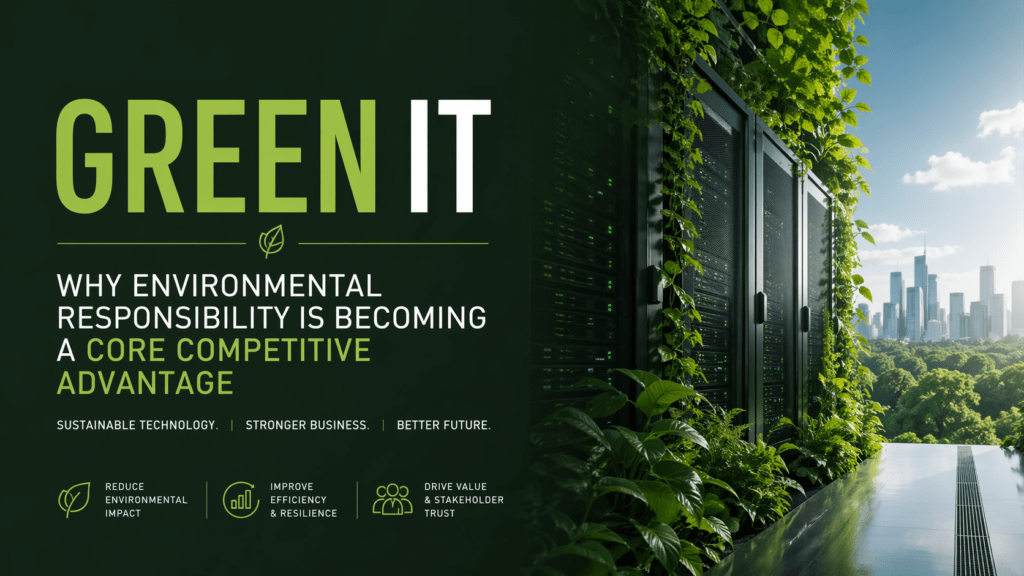
Today, environmental responsibility in technology — what industry leaders now call Green IT — has moved from the CSR department straight into the boardroom. It’s shaping procurement decisions, investor mandates, talent acquisition, and long-term competitive positioning. Whether you lead a startup or a global enterprise, if you’re not thinking about the environmental footprint of your technology stack, you’re already falling behind.
Let’s unpack why this shift is happening, what it really means in practice, and — most importantly — how you can turn it into a genuine competitive edge.
🌍 The New Business Reality: ESG Is No Longer Optional
ESG — Environmental, Social, and Governance — used to be a framework primarily for institutional investors. Today, it’s a full-spectrum business imperative.
Here’s what the landscape looks like right now:
- Regulatory pressure is intensifying. The EU’s Corporate Sustainability Reporting Directive (CSRD) now requires thousands of companies to disclose detailed sustainability data — including their digital infrastructure’s energy consumption.
- Investors are demanding it. BlackRock, Vanguard, and State Street — collectively managing tens of trillions in assets — have made ESG criteria central to their portfolio evaluations.
- Clients and partners are screening for it. Enterprise procurement teams increasingly include environmental benchmarks in vendor qualification processes.
- Talent expects it. A 2023 Deloitte survey found that over 40% of Gen Z and Millennial employees have turned down or considered turning down employers based on their environmental stance.
The message is clear: Environmental responsibility is now a table-stakes business requirement, and Green IT is where technology companies must lead.
💡 What Is Green IT, Really?
Green IT refers to the design, manufacture, use, and disposal of computing technology in ways that minimize environmental impact. But in its modern form, it goes much deeper than hardware recycling programs.
The three pillars of contemporary Green IT are:
1. 🏗️ Data Center Energy Consumption
Data centers currently consume roughly 1–2% of global electricity — a figure that’s growing exponentially as AI, cloud services, and streaming scale up. For context:
| Comparison | Energy Equivalent |
|---|---|
| One large data center (annual) | ~1 million average US homes |
| Training GPT-3 once | ~552 tons of CO₂ |
| Global data centers (2023) | ~200–250 TWh/year |
| Projected global usage by 2030 | Potentially 3–4x current levels |
The hyperscalers — Microsoft, Google, Amazon — are racing to achieve carbon-neutral or carbon-negative data infrastructure. Google has committed to running on 24/7 carbon-free energy by 2030. Microsoft aims to be carbon negative by the same year. These aren’t just PR moves. They’re strategic repositioning efforts designed to win enterprise clients who are themselves under ESG scrutiny.
2. 🧑💻 Carbon-Neutral Software Development
This is the frontier most businesses aren’t thinking about yet — which means it’s one of the biggest opportunities.
Carbon-neutral software is code engineered to minimize computational waste:
- Efficient algorithms that require fewer CPU cycles
- Optimized databases that reduce query loads
- Lazy loading and caching architectures
- AI inference optimization (smaller models, quantization, edge computing)
- Green coding practices embedded in CI/CD pipelines
The concept of “software carbon intensity” (SCI) — a metric published by the Green Software Foundation — is gaining traction as a way to measure and reduce the carbon footprint of software at the code level. Some forward-thinking CTOs are already adding SCI metrics to their engineering KPIs.
3. 🛒 Sustainable Tech Procurement
How and from whom you buy your hardware and software matters. Sustainable procurement means:
- Choosing vendors with verified carbon-neutral operations
- Prioritizing refurbished or energy-efficient hardware
- Selecting cloud providers with strong renewable energy commitments
- Evaluating the full lifecycle environmental cost of devices and infrastructure
- Demanding supply chain transparency from technology partners
📊 The Competitive Advantage: By the Numbers
Here’s why this isn’t just altruism — it’s smart business strategy.
| Business Area | Impact of Green IT |
|---|---|
| Customer acquisition | 66% of global consumers willing to pay more for sustainable brands (Nielsen) |
| Investor access | ESG-compliant companies attract 30%+ more institutional investment |
| Operational costs | Energy-efficient infrastructure reduces OpEx by 20–40% |
| Regulatory compliance | Avoid fines, bans, and reputational damage in regulated markets |
| Talent attraction | 76% of job seekers consider a company’s social and environmental commitments |
| Partnership eligibility | Major enterprises now include green criteria in vendor RFPs |
The bottom line: Green IT is a margin story as much as it is a values story.
🚀 Five Strategic Moves to Build a Green IT Competitive Advantage
✅ 1. Conduct a Digital Carbon Audit
You can’t manage what you don’t measure. Start with a baseline assessment of your organization’s digital carbon footprint:
- Cloud infrastructure energy usage (your provider’s sustainability dashboards are a starting point)
- Employee device lifecycle and disposal practices
- Software inefficiencies that create unnecessary compute load
- Travel and hardware shipping emissions
Tools like Climatiq, Cloud Carbon Footprint (open source), and Greenpixie make this increasingly accessible, even for mid-market companies.
✅ 2. Shift to Green Cloud Providers — or Demand Accountability from Yours
Not all clouds are created equal. When evaluating or renegotiating cloud contracts, ask the hard questions:
- What percentage of your energy comes from renewable sources?
- Do you publish Power Usage Effectiveness (PUE) ratios?
- What is your roadmap to carbon neutrality?
- Do you offer carbon reporting APIs for our workloads?
The major providers — Google Cloud, Microsoft Azure, AWS — each publish sustainability reports, but their commitments vary significantly. Smaller regional providers often lag far behind. Make this part of your procurement criteria, not an afterthought.
✅ 3. Embed Green Engineering into Your Development Culture
This is where technology-forward companies can differentiate most rapidly:
- Introduce Green Software Foundation principles into engineering onboarding
- Add energy efficiency as a code review metric alongside performance and security
- Use cloud cost optimization tools (which also reduce energy use — efficiency and sustainability align here)
- Explore edge computing for workloads that don’t need centralized data center processing
- Adopt serverless architectures that scale to zero, eliminating idle compute waste
The engineers who understand sustainable software design will be among the most valuable professionals of the next decade.
✅ 4. Build ESG Transparency into Your Brand
Once you’ve started making meaningful progress, communicate it clearly and credibly:
- Publish an annual Digital Sustainability Report — even a concise one signals leadership
- Obtain third-party certifications where possible (ISO 14001, B Corp, Science Based Targets initiative)
- Feature sustainability metrics on your website and in investor/client decks
- Share your journey openly, including current gaps and improvement roadmaps
Authenticity matters. “Greenwashing” — making sustainability claims without substance — is increasingly being called out by regulators, journalists, and savvy customers. Don’t overstate. Do the work, then tell the story.
✅ 5. Align Green IT with Business Outcomes, Not Just Values
The most powerful reframe you can make is this: stop presenting sustainability as a cost center and start presenting it as a value driver.
When you pitch Green IT internally or to stakeholders, frame it around:
- Risk reduction — ahead of regulatory mandates, not scrambling to meet them
- Cost efficiency — energy optimization saves money at scale
- Market access — some enterprise and government contracts now require ESG compliance
- Brand equity — sustainability is increasingly a purchasing decision factor
- Innovation signal — green engineering attracts elite engineering talent
The CFO who doesn’t care about carbon cares deeply about margins, risk, and growth. Speak that language.
🌱 The Companies Already Winning
Let’s look at organizations demonstrating that Green IT isn’t just possible — it’s profitable.
Google operates the world’s largest corporate purchase of renewable energy and has maintained carbon neutrality since 2007. They’ve built this into a core enterprise sales advantage, particularly with government and financial services clients.
SAP embedded sustainability metrics directly into their enterprise software suite, making it easier for their clients to track and report ESG data. This has become a meaningful product differentiator in competitive deals.
Patagonia — not a tech company, but instructive — has built a multi-billion-dollar brand almost entirely on the authenticity of its environmental commitments. Technology companies can and should learn from this playbook.
Infosys committed to carbon neutrality in 2020 and has turned its sustainability credibility into a competitive asset in global IT services procurement.
The pattern is clear: early movers are capturing the advantage while late adopters scramble to catch up.
🔮 What’s Coming Next: The Horizon of Green IT
The trajectory is only accelerating. Here’s what’s emerging on the near horizon:
| Emerging Trend | Timeline | Business Impact |
|---|---|---|
| Mandatory carbon reporting for digital infra | 2025–2027 (EU/UK first) | Compliance requirement for market access |
| AI energy efficiency standards | 2026+ | Procurement criteria for AI vendors |
| Green software labeling | Early stages | Consumer and enterprise differentiation |
| Carbon-aware computing | Now (early adopters) | Significant OpEx reduction potential |
| Circular hardware economy | Scaling now | Supply chain risk reduction |
| Scope 3 digital emissions disclosure | 2026–2028 | Full value-chain accountability |
The organizations building these capabilities today will define the competitive landscape of tomorrow.
Final Thought: This Is a Leadership Moment
Green IT is not a technology trend. It’s a leadership inflection point.
The question for every executive, every technology leader, every founder is no longer “should we take this seriously?” — the answer to that is already written in the regulatory pipelines, investor mandates, and customer expectations bearing down on every sector.
The real question is: “Do we lead this transformation, or do we react to it?”
Those who lead will shape the standards. They’ll attract the best talent, the best clients, and the best capital. They’ll build organizations that are resilient to coming regulatory shifts rather than blindsided by them.
The environment is no longer just a moral responsibility. It’s a competitive one.
And the clock on first-mover advantage is ticking.
Enjoyed this article? Share it with a colleague who’s navigating the intersection of technology strategy and sustainability. And if you’d like to explore how Green IT principles apply specifically to your organization, reach out — this is exactly the kind of strategic challenge I work on.
Tags: Green IT ESG Sustainability Digital Transformation Competitive Strategy Carbon Neutral Data Centers Tech Leadership