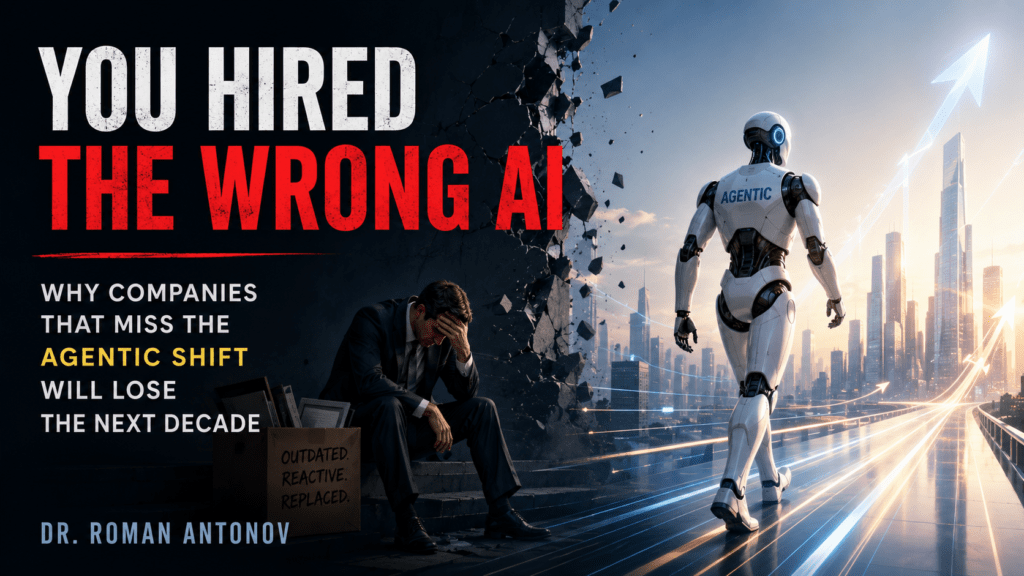
“Most companies didn’t hire AI. They hired a very fast assistant. The companies about to eat their lunch hired a workforce.”
Picture this. Your company has AI. You’re proud of it. You have a chatbot on the website, Copilot embedded in your dev team’s IDE, a summarization tool your ops team uses on Monday mornings. You’ve cut costs. You’ve sped things up. Your board slides have a slide that says “AI-Enabled Organization.”
Meanwhile, your fastest-moving competitor is running forty AI agents — autonomously prospecting leads, filing compliance reports, writing and deploying code, managing customer escalations, and updating their product roadmap based on real-time usage data — while their human team sleeps.
You didn’t fall behind on AI adoption. You fell behind on which kind of AI you adopted.
That distinction is going to define competitive winners and losers for the rest of this decade. And most executive teams are only just beginning to understand it.
The AI You Hired vs. The AI That’s Coming for Your Market
There are two fundamentally different types of AI operating in the world today. They use some of the same underlying technology. They sound similar in vendor pitches. But they are strategically different in almost every way that matters.
Reactive AI — the kind most organizations have deployed — waits for a human to ask it something. It answers a question. It completes a task. It summarizes a document. Then it stops. It doesn’t plan. It doesn’t pursue a goal. It doesn’t decide what to do next. It is, at its core, a sophisticated input-output machine.
Agentic AI is different in a way that changes everything. It receives a goal, not a prompt. It plans the steps required to achieve that goal. It selects and uses tools — web browsers, databases, APIs, code environments — to act in the world. It evaluates its own progress, corrects errors, and adapts when things don’t go as expected. Then it keeps going until the goal is met.
The difference isn’t technical. It’s organizational. One is a tool. The other is a team member.
And right now, companies that understand this are quietly building something that will be very hard to compete against in three to five years.
What “Agentic AI” Actually Means — Without the Jargon
The term gets thrown around a lot, so let’s be precise. An AI agent is a system that exhibits four properties that ordinary AI tools don’t:
- Goal-directedness — It works toward a defined objective, not just a single response
- Multi-step reasoning — It plans and executes sequences of actions, not one-shot outputs
- Tool use — It can interact with external systems: search the web, read files, call APIs, write and run code
- Self-correction — When a step fails or produces unexpected results, it adjusts and tries again
When you chain multiple agents together — each with its own specialty and goal — you get what Gartner calls a multi-agent system: a network of AI actors that can tackle complex, cross-functional problems at machine speed.
Here’s the clearest comparison I can offer:
| Dimension | Reactive AI | Agentic AI |
|---|---|---|
| Input | A prompt or question | A goal or objective |
| Output | A single response | A completed task or outcome |
| Autonomy | Zero — waits for human direction | High — acts independently between checkpoints |
| Tool use | None (text in, text out) | Browsers, APIs, databases, code execution |
| Error handling | None — returns what it can | Self-corrects and retries |
| Human involvement | Every step | Defined checkpoints only |
| Speed | Fast per response | Fast per project |
| Competitive impact | Efficiency gain | Structural advantage |
That last row is the one executives need to sit with. Efficiency gain is nice. Structural advantage is what wins markets.
The Agentic Spectrum: Where Most Companies Are Stuck
Agentic AI isn’t binary — it’s a spectrum. Understanding where your organization sits on it is the first honest assessment any leadership team should make.
| Stage | Description | Example | Competitive Implication |
|---|---|---|---|
| Stage 1 — Chatbot | Answers questions, handles simple FAQs | Website support bot | None — table stakes since 2020 |
| Stage 2 — Copilot | Assists humans completing tasks | GitHub Copilot, Copilot in Office | Productivity boost, easy to replicate |
| Stage 3 — Workflow AI | Automates defined, repetitive processes | Invoice processing, ticket routing | Operational efficiency, moderate differentiation |
| Stage 4 — AI Agent | Pursues multi-step goals autonomously | AI sales development rep, AI QA engineer | Significant speed and cost advantage |
| Stage 5 — Multi-Agent System | Networks of specialized agents collaborating | Full product development pipeline, autonomous ops | Structural competitive moat |
Most organizations deploying AI in 2026 sit at Stage 2 or Stage 3. The companies currently pulling away from the pack are at Stage 4. The companies that will be untouchable by 2029 are already building toward Stage 5.
The gap between Stage 3 and Stage 4 is not a technical gap. It is a strategic and organizational one. And it is widening every quarter.
Why the Agentic Shift Changes Competitive Dynamics — Fundamentally
When a company moves from reactive AI to agentic AI, three things change simultaneously. Each one is significant on its own. Together, they create a competitive reality that is genuinely difficult to reverse.
1. Speed Asymmetry
A human team working on a complex deliverable — a market analysis, a software feature, a compliance report — moves at human speed. Meetings, handoffs, reviews, approvals. An agent-powered workflow runs continuously. It doesn’t have meetings. It doesn’t wait for someone to come back from lunch. It doesn’t lose context between sessions.
The result is not a 10% or 20% speed advantage. In the right workflows, it’s a 10x or 100x speed advantage. And in markets where speed-to-insight or speed-to-market is a differentiator, that is a decisive gap.
2. Cost Asymmetry
When AI agents handle multi-step knowledge work, the economics of scaling change completely. A traditional company that wants to double its output must roughly double its headcount — hiring, onboarding, management overhead, real estate, benefits. A company running agentic workflows can double output by provisioning more compute. The marginal cost of scaling is a fraction of the human equivalent.
This doesn’t just mean leaner operations. It means competitors can enter your market at price points that are structurally impossible for you to match — while still making healthy margins.
3. The Compounding Capability Gap
Here is what makes the agentic shift genuinely dangerous for laggards: every month you delay compounds the gap.
Agentic systems improve through use. The organization operating them builds institutional knowledge about how to deploy them, orchestrate them, and trust them in high-stakes workflows. That knowledge doesn’t exist in a document — it lives in the team, in the tooling, in the tested playbooks. Companies that start now are building that capability accumulation. Companies that wait are watching the gap widen in real time.
This is not like upgrading software. You can’t buy a catch-up.
Real-World Playbooks: How Leading Companies Are Already Doing This
Salesforce: Agentforce and the Autonomous Sales Floor
Salesforce launched Agentforce — a platform for deploying autonomous AI agents across sales, service, and operations. These aren’t chatbots answering product questions. These are agents that autonomously handle inbound leads, qualify prospects, schedule follow-ups, draft proposals, and escalate to humans only when genuinely needed.
The competitive lesson: Salesforce isn’t selling a CRM anymore. It’s selling an AI-powered autonomous revenue operation. The switching cost isn’t just migrating data — it’s dismantling a workforce. That’s a moat.
Cognition AI: Devin and the AI Software Engineer
Devin, built by Cognition AI, is the first commercially deployed AI software engineering agent. It doesn’t complete code snippets. It takes engineering tickets, plans the implementation, writes the code, runs the tests, debugs failures, and opens pull requests. It operates as a member of the engineering team.
The competitive lesson: Any software company that deploys engineering agents effectively multiplies its development capacity without adding headcount. The first-mover advantage in adoption, debugging, and integration know-how is enormous — and time-limited.
ServiceNow: Agents That Run the Enterprise
ServiceNow rebuilt its platform around autonomous agents that handle IT service requests, HR workflows, and operational processes end-to-end. An employee submits a request; an agent resolves it, pulling from systems, updating records, and routing exceptions — without a human touching it.
The competitive lesson: In enterprise software, the company that embeds agents deepest into operational workflows owns the account. The agent isn’t a feature. It’s the reason leaving is operationally unthinkable.
Google DeepMind: Agents That Do Science
DeepMind’s agentic research systems are now autonomously running experiments, generating hypotheses, and analyzing results in fields from protein folding to materials science. Research that took human scientists months is being run in days.
The competitive lesson: In any knowledge-intensive industry — pharma, engineering, finance, consulting — the organization that deploys agents capable of autonomous research and analysis will outpace human-speed competitors in ways that become structural over time.
The Three Companies in Every Market Right Now
Look carefully at your competitive landscape. There are exactly three types of companies in any sector today.
🟢 The Pioneers (roughly 5–10% of any market)
They are already running agentic systems in production. Not pilots. Not sandbox experiments. Production. They have made real organizational changes — rewriting job descriptions, restructuring workflows, building internal expertise in agent orchestration. They are learning things their competitors don’t know yet. Every week that passes, that advantage compounds.
🟡 The Experimenters (roughly 30–40% of any market)
They are running pilots. They have a team exploring agentic AI. They’ve had the conversations. But the transition from pilot to production is where organizations stall — because it requires genuine process redesign, not just a new tool. Experimenters are moving. But they’re moving in slow motion relative to the Pioneers.
🔴 The Watchers (the majority)
They are still framing this as a future consideration. They’re waiting for the technology to mature. They’re waiting for best practices to emerge. They’re waiting for a use case that feels safe enough to commit to.
Here is the uncomfortable truth about waiting for certainty in a structural shift: by the time the risk feels manageable, the opportunity is already gone.
What You Are Actually Risking
This is the part most articles on agentic AI leave out. They talk about what you stand to gain. Let’s talk about what you stand to lose — specifically.
Market share at the margin, then in bulk. Competitive displacement in technology markets rarely happens all at once. It starts at the margins — a slightly faster competitor, a slightly lower price point, a slightly better product. Then it accelerates. By the time it feels existential, the gap is very hard to close.
Talent gravity. The best engineers, product managers, and operators increasingly want to work with cutting-edge AI systems. Organizations running agentic workflows attract the talent that builds them. Organizations that don’t start losing the talent war in a way that makes the capability gap self-reinforcing.
Pricing power. When competitors can deliver comparable output with dramatically lower cost structures, margin compression follows. And if your cost base is still predominantly human labor while theirs is compute, you are not in the same economic fight.
The chance to learn while the technology is young. This is the most underrated risk of all. The organizations that will be best at agentic AI in 2030 are the ones learning it now, when mistakes are cheap and the competitive stakes are still low enough to absorb them.
The Agentic Readiness Audit: Where Does Your Company Actually Stand?
Be honest with these questions. The answers will tell you more than any analyst report.
On Your AI Architecture:
- Are your current AI tools reactive (responding to prompts) or autonomous (pursuing goals)?
- Have you deployed any AI agent in a production workflow — not a demo, not a pilot?
- Do your AI systems use external tools (APIs, databases, browsers) to complete tasks?
On Your Data Infrastructure:
- Is your proprietary data accessible and structured enough to power autonomous agents?
- Do your systems generate feedback loops that allow agents to improve from real-world outcomes?
- How long does it take to get a new data source integrated into your AI stack?
On Your Organization:
- Have you redesigned any core process around an AI agent — rather than adding AI to an existing process?
- Do your leaders have genuine fluency in what agentic AI can and cannot do today?
- Is “AI agent deployment” owned by a dedicated function, or bouncing between teams?
On Your Competitive Awareness:
- Do you know which of your competitors are running agents in production?
- Have you mapped the workflows in your business where agent-speed would create a decisive competitive advantage?
- Is your AI roadmap explicitly connected to competitive positioning, or primarily to internal efficiency?
If you answered “no” or “not sure” to more than half, your competitive exposure is larger than your leadership team probably realizes. That’s not a criticism — it’s a starting point.
Your 4-Move Playbook to Start Closing the Gap
The goal here is not to tell you to boil the ocean. Agentic AI transformation done badly is worse than not doing it at all — failed deployments burn credibility and slow down the organizations that most need to move fast. Here are four concrete moves.
Move 1: Identify Your Highest-Value Agentic Opportunity
Don’t start with the most complex workflow. Start with the one that meets three criteria: high volume, well-defined success criteria, and current bottleneck status. The process your team complains about most, that involves the most repetitive human decision-making, is almost certainly your best first agent deployment.
Move 2: Build One Agent and Run It to Production
Not a demo. Not a proof of concept that lives in a Jupyter notebook. A real agent, in a real workflow, with real outputs that matter to real people. The organizational learning that comes from the first production deployment is worth more than any amount of planning.
Move 3: Create an Agent Operations Function
Agentic AI doesn’t run itself — it needs human oversight, quality assessment, continuous improvement, and escalation handling. This is a new kind of operational function that most organizations don’t have yet. Building it early is a competitive advantage in itself.
Move 4: Connect Agent Performance to Competitive Metrics
This is where most AI initiatives get lost. They measure inputs (hours saved, tokens generated) instead of outputs (market share moved, revenue per employee, speed-to-market). If you can’t connect your agent deployment to a competitive metric, you’re building an efficiency program. Efficiency programs don’t build moats.
The Closing Provocation
Ten years ago, companies that missed the mobile shift didn’t just fall behind. They became irrelevant. The window to adapt looked longer than it was, and by the time the urgency felt real, the leaders had compounding advantages that made catching up structurally difficult.
The agentic shift is not as slow as mobile. The capability curve is steeper. The cost of entry is lower. And the competitive implications for knowledge-intensive industries — software, professional services, finance, healthcare, logistics, and more — are profound.
You don’t have to be a Pioneer on day one. But you do have to decide which of the three companies you want to be. Because the market is going to decide for you if you wait long enough.
You hired the wrong AI. The question now is whether you hire the right one before your competition gets too far ahead to catch.
Dr. Roman Antonov is a PMP-certified Project and Product Manager with a PhD in Economics and 11 years of experience driving multimillion-dollar growth across software engineering and digital product development. He writes about IT competitiveness, digital strategy, and the forces reshaping how technology companies win and lose.