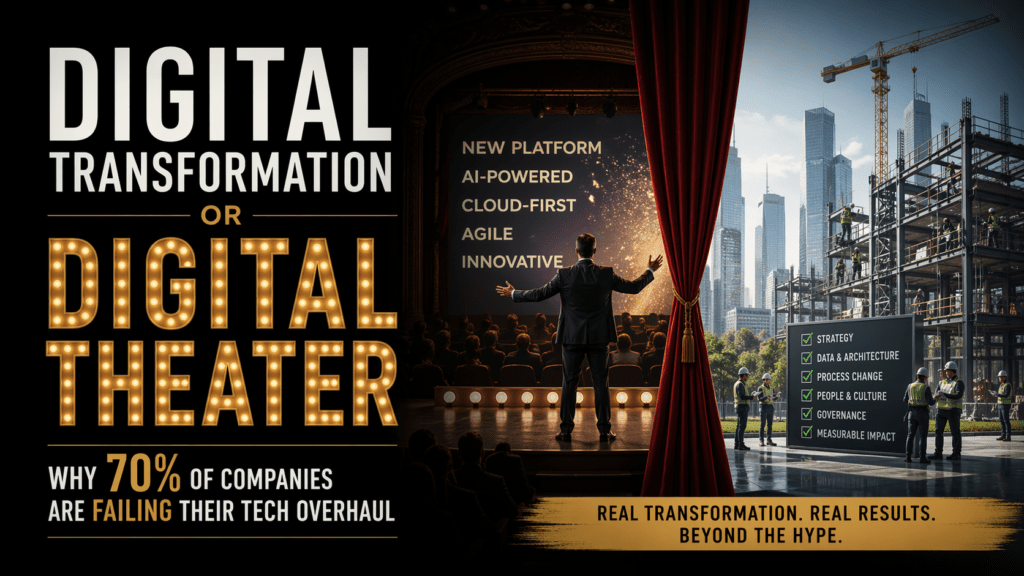
“We are digitally transforming.” Three words. Endless PowerPoint decks. Millions of dollars. And yet — for the vast majority of companies — almost nothing fundamentally changes.
If you’ve sat in a boardroom recently, you’ve heard it. The bold announcement. The consultant-speak. The promise of a leaner, faster, AI-powered future. But here’s the uncomfortable truth that nobody wants to say out loud: most digital transformation initiatives are not transformations at all. They are performances.
McKinsey research consistently shows that roughly 70% of digital transformation programs fail to achieve their stated goals. Gartner puts it even more bluntly, noting that most organizations are simply “adding digital features to analog thinking.” So what’s going wrong — and more importantly, what does genuine transformation actually look like?
Let’s cut through the theater.
The Diagnosis: Why the 70% Are Stuck
Before we talk solutions, we need to name the disease. The failure of digital transformation isn’t primarily a technology problem. The tools are largely available, affordable, and proven. The failure is organizational, behavioral, and strategic — rooted in how companies think about change.
Here are the most common failure patterns you’ll see in the wild:
1. Mistaking Digitization for Transformation
Companies frequently digitize their existing broken processes without questioning whether those processes should exist at all. Putting a bad workflow into software doesn’t fix the workflow — it just makes the inefficiency faster.
Digitization is paving a cow path. Transformation is asking why the cow needs to walk there at all.
2. The “Big Bang” Illusion
Leadership announces a sweeping, company-wide overhaul. Budgets are approved. Timelines are set. Two years later, costs have tripled, morale has cratered, and the system still doesn’t work as promised. This is the “Big Bang” approach — attempting to change everything at once — and it is a recipe for disaster.
3. Technology as a Trophy, Not a Tool
Some organizations adopt new technology to signal modernity rather than to solve real problems. The latest AI platform becomes a trophy on the shelf, deployed without clear use cases, without user training, and without any mechanism to measure whether it’s working.
4. The Culture Gap
Perhaps the most underestimated killer. You cannot bolt a digital culture onto an analog organization. If your people don’t feel safe to experiment, fail, iterate, and learn, no amount of technology investment will create adaptive, resilient processes.
Anatomy of the Theater: A Recognition Guide
How do you know if your organization is performing transformation rather than achieving it? Look for these telltale signs:
| Digital Theater | Genuine Transformation |
|---|---|
| Transformation is a project with an end date | Transformation is a continuous capability |
| Success is measured by tech deployed | Success is measured by outcomes delivered |
| Led by a single “Chief Digital Officer” silo | Embedded across every function and team |
| Employees receive a training PDF and a login | Culture actively rewards experimentation |
| Vendors and consultants define the roadmap | Internal teams own strategy and learning |
| Reports and dashboards multiply | Decisions actually become faster and better |
| The word “agile” appears in the deck, nowhere else | Agile is how work actually gets done |
If you recognized your organization in the left column — welcome to the majority. The good news: awareness is the first act of genuine change.
The Theoretical Backbone: Frameworks That Actually Explain What’s Happening
To move beyond symptoms, we need frameworks that explain why organizations fail to adapt — and what a structurally sound transformation looks like. Here are the most powerful lenses for thinking about this.
Framework 1: The Three Horizons of Growth (McKinsey)
Originally developed by McKinsey, the Three Horizons Model distinguishes between:
- Horizon 1 — Optimizing the core business (today’s revenue engine)
- Horizon 2 — Emerging opportunities that will become tomorrow’s core
- Horizon 3 — Exploring transformative, speculative possibilities
Most digital transformation programs operate almost exclusively in Horizon 1 — they optimize what exists. The organizations that achieve genuine transformation invest simultaneously across all three horizons, creating new capability while maintaining current operations.
The critical mistake: Companies underfund Horizon 2 and 3 because they have no immediate ROI. But this is precisely where transformation lives.
Framework 2: The Cynefin Framework — Knowing What You Don’t Know
Developed by Dave Snowden at IBM, Cynefin (pronounced “kih-nev-in”) categorizes problems into five domains:
- Clear — Best practices apply. Cause and effect are obvious.
- Complicated — Good practices apply. Expertise required to find the right answer.
- Complex — Emergent practices. Cause and effect only understood in retrospect.
- Chaotic — Novel practices. Act first, then sense.
- Disorder — You don’t know which domain you’re in.
The reason digital transformation so often fails? Leadership tries to manage Complex problems as if they were Complicated ones. They bring in experts, define requirements upfront, and execute a waterfall plan — when the environment actually demands continuous sensing, experimentation, and adaptation.
Genuine transformation means embracing the Complex domain: running multiple small experiments, learning from feedback loops, and updating course constantly.
Framework 3: The Ambidextrous Organization
Harvard Business School professor Michael Tushman introduced the concept of the Ambidextrous Organization — one that can simultaneously:
- Exploit existing capabilities (efficiency, optimization, scale)
- Explore new capabilities (innovation, disruption, experimentation)
Most organizations are structurally wired for exploitation. The quarterly earnings cycle, the annual budget process, the command-and-control hierarchy — all of it favors optimization over exploration.
Genuine digital transformation requires building structural ambidexterity — separate but connected spaces where exploration is protected from the gravity of short-term performance metrics.
Framework 4: Kotter’s Dual Operating System
John Kotter’s updated model argues that the traditional hierarchical structure — while excellent for running stable operations — is fundamentally incompatible with the speed of change required in today’s environment.
His solution: a Dual Operating System.
HIERARCHY (Reliability)          NETWORK (Agility)
─────────────────────            ──────────────────
Formal structure                 Voluntary, cross-functional
Command & control                Self-organizing
Annual cycles                    Continuous, iterative
Risk-averse                      Experimental
Optimize for today               Build for tomorrow
The network side of the dual system is where transformation happens. Critically, it is not a skunkworks project that gets shut down when times get tough. It is structurally embedded and permanently resourced.
Framework 5: The Adaptive Cycle (Panarchy Theory)
Borrowed from ecology, the Adaptive Cycle describes how complex systems — including organizations — move through four phases:
- Growth (r) — Rapid expansion, opportunity exploitation
- Conservation (K) — Stability, efficiency, rigidity
- Release (Ω) — Disruption, collapse of accumulated rigidity
- Reorganization (α) — Innovation, renewal, reconfiguration
Most large organizations are stuck in the Conservation phase — optimized, efficient, and utterly brittle. Digital transformation that works accelerates the passage through Release and Reorganization, rather than trying to avoid it.
The paradox: organizations that try hardest to avoid the Release phase (by doubling down on stability and control) end up experiencing the most traumatic collapses. Those that build adaptive capacity — accepting small failures regularly — prove far more resilient.
The Anatomy of Genuine Transformation: What It Actually Looks Like
So what does it look like when a company gets this right? Here’s a composite framework drawing from the above models:
The Five Pillars of Adaptable Digital Transformation
Pillar 1: Start With the Problem, Never the Technology Define the specific human and business problem you’re solving before a single vendor conversation occurs. Every tool adopted should map to a measurable outcome. No tool, no matter how impressive the demo, justifies itself.
Pillar 2: Build Learning Infrastructure, Not Just Digital Infrastructure The real competitive advantage of a digitally transformed organization is not its software stack — it’s its capacity to learn faster than its competitors. Invest in feedback loops, retrospectives, data literacy across all teams, and decision-making processes that systematically capture and act on new information.
Pillar 3: Design for Optionality Avoid monolithic, all-or-nothing implementations. Architect your technology and organizational design so that you can pivot, swap components, and experiment at the margins without catastrophic disruption to the core. This is what engineers call loose coupling — and it applies to strategy just as much as to software.
Pillar 4: Treat Culture as a System, Not a Slogan You cannot change culture through communication. Culture changes through repeated behavior, reinforced by consequences. If people who take calculated risks and fail are punished, your culture will not support transformation — regardless of what the values poster on the wall says. Change the incentives, the rituals, the stories, and the decision-making norms.
Pillar 5: Distribute Leadership, Centralize Learning The most adaptive organizations flatten decision-making authority close to the customer and the work, while centralizing the synthesis of what’s being learned. This is the opposite of most corporate digital programs, where strategy is centralized and learnings are siloed inside project teams.
The Metrics of Real Transformation vs. Vanity Metrics
One of the clearest signs of digital theater is an obsession with input metrics rather than outcome metrics. Here’s how to tell the difference:
| Vanity Metrics (Theater) | Outcome Metrics (Transformation) |
|---|---|
| Number of employees trained on new platform | Change in decision speed or quality after training |
| Number of AI use cases identified | Revenue or cost impact of AI use cases deployed |
| Digital transformation budget spent | Value delivered per dollar invested |
| Number of dashboards created | Reduction in time from insight to action |
| Agile ceremonies conducted | Time-to-market for new customer-facing capabilities |
| Employee satisfaction with new tools | Customer outcome improvement attributable to tools |
Track what changes in the world. Not what changes in the presentation.
A Practical Diagnostic: Is Your Transformation Real?
Ask your leadership team these ten questions. Be honest. The discomfort in the room will tell you more than the answers.
- Can you name a specific decision that was made differently because of your digital transformation initiative?
- Who was the last person rewarded — publicly, visibly — for a failed experiment that generated valuable learning?
- What is the shortest feedback loop between a frontline employee observing a customer problem and that problem influencing your product or process roadmap?
- If your Chief Digital Officer left tomorrow, would the transformation continue or collapse?
- What percentage of your transformation budget is allocated to changing how people work, versus changing what tools they have?
- Can every team member articulate what success looks like — in customer terms — for their part of the transformation?
- What have you stopped doing as a result of this transformation? (Genuine transformation creates space; it doesn’t just add to the pile.)
- Is your transformation roadmap defined by a consultant’s methodology, or by your own customer and employee feedback?
- What is the smallest possible experiment you could run this week to test a transformation hypothesis?
- Is your executive team willing to be publicly wrong about something in service of learning faster?
Score honestly: If you couldn’t answer more than five of these with confidence, your organization is likely engaged in digital theater.
The Path Forward: From Theater to Transformation
The shift from digital theater to genuine transformation is not primarily a technology investment — it is an institutional maturity investment. It requires:
- Honesty about the gap between announcement and reality
- Patience for the compounding effects of genuine capability-building
- Courage to make structural changes that short-term incentives resist
- Humility to learn from outside your industry, your hierarchy, and your assumptions
The 30% of organizations that succeed at digital transformation are not smarter, better-funded, or luckier than the 70% that fail. They are simply more honest about what transformation actually requires — and more willing to do that work rather than perform it.
The best time to start was five years ago.
The second-best time is now — but only if you’re ready to stop the show.
Key Takeaways
- 70% of digital transformations fail because they address technology without addressing organizational culture, incentives, and learning capacity.
- Digital theater is the performance of transformation: announcements, tools, and decks that produce no measurable change in how value is delivered.
- The Cynefin, Three Horizons, Ambidextrous Organization, Kotter Dual Operating System, and Adaptive Cycle frameworks all converge on the same insight: genuine transformation requires structural ambidexterity, distributed experimentation, and continuous learning.
- Outcome metrics beat vanity metrics every time. Measure what changes in the world.
- Culture is a system, not a slogan. It changes through repeated behavior and reinforced consequences — not through training programs or values workshops alone.
- The organizations that succeed treat transformation as a permanent operating capability, not a project with a budget and an end date.
Roman Antonov works at the intersection of strategy, organizational design, and genuine business transformation. If your organization is ready to move from digital theater to digital transformation, reach out at drromanantonov.com.
© drromanantonov.com | All rights reserved