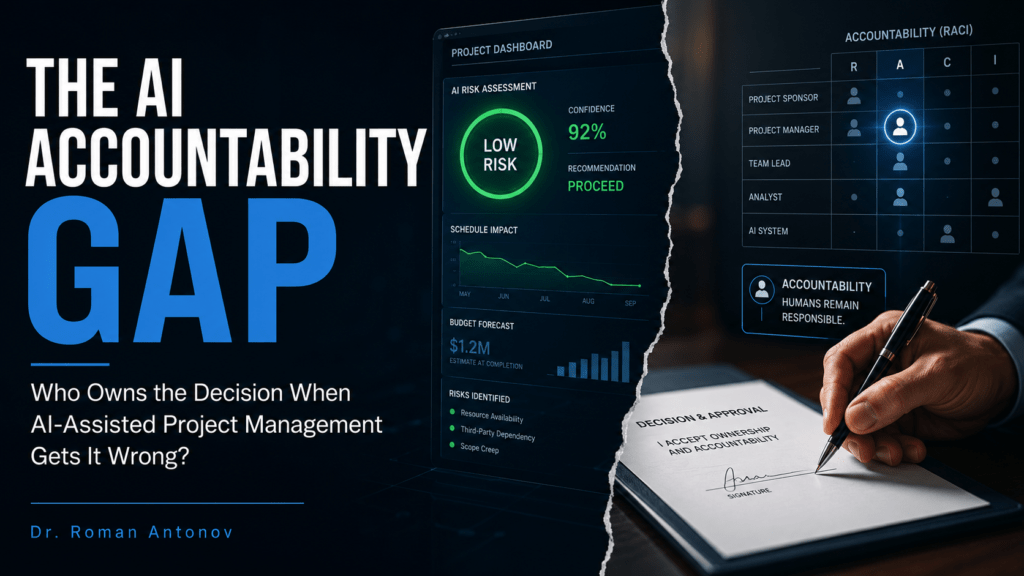
“The AI flagged it green. The AI said the vendor would deliver on time. The AI said the budget had headroom.” None of those sentences will save your job when the project blows up.
Here’s the question almost nobody in project management wants to answer out loud in 2026: when the algorithm is wrong, who signs the apology email?
Not the vendor who sold you the tool. Not the data science team who trained the model on someone else’s history. You — the project manager, the PMO lead, the delivery director who clicked “approve.” AI doesn’t sit in the steering committee meeting. You do.
That’s the accountability gap. And it’s opening faster than most organizations are willing to admit.
The Split Nobody’s Talking About
Two numbers should be sitting side by side on every PMO dashboard right now, and they almost never are.
- 75% of global knowledge workers say they’re using generative AI at work.
- Only 44% of project teams report actually relying on AI-assisted PM features — things like automated risk alerts or task suggestions — inside their real workflows.
Read that gap carefully. It doesn’t mean AI adoption in project management is slowing down. It means most of it is happening off the books — in side chats, personal drafting tools, and ad hoc “let me just check this with AI” moments that never touch the official project record. The formal PM workflow — the one with an audit trail, a change log, a documented decision — is still catching up.
That’s not a technology problem. That’s a governance vacuum. And vacuums get filled by whoever’s willing to make the call — usually without anyone deciding they should be the one making it.
From “Did You Adopt AI?” to “Who’s Accountable for It?”
For the last two years, the industry conversation was simple, almost gleeful: adopt AI or get left behind. I’ve made that argument myself. But somewhere in 2026, the conversation quietly matured, and the smarter operators in this field started asking a much harder question.
The emerging consensus, echoed across project management circles this year, is blunt: AI maturity in a PM function shouldn’t be measured by whether your team can operate an AI tool. It should be measured at the decision level — whether the outputs of that tool are governed the way any other input to a forecast, budget, or contractual commitment would be.
That reframing matters enormously, because it quietly kills the most common excuse in the room: “the AI suggested it.”
An AI suggesting a schedule slip, a resource reallocation, or a risk score is not a decision. It’s an input. The decision — and the accountability that comes with it — still belongs to a human who is paid, trained, and certified to own outcomes. If your organization can’t point to who that human is for every AI-influenced call on a project, you don’t have an AI strategy. You have a liability generator with a nice dashboard.
What “Governing AI” Actually Requires
Based on where the more rigorous parts of the industry are landing, real AI governance in project delivery rests on four disciplines — and notably, all four are things a Six Sigma or PMP practitioner should recognize instantly, because they’re just quality control and change management wearing a new hat:
- Source-data controls — knowing exactly what data trained or fed the AI’s recommendation, and whether that data was clean, current, and relevant to this project, not some averaged-out global dataset.
- Documented human review — a paper trail showing a qualified person actually looked at the AI’s output before it became a decision, not a rubber stamp applied after the fact.
- Accountability for approved outputs — a named owner for every AI-influenced forecast, budget line, or risk rating, the same way you’d name an owner for a manually built one.
- Escalation protocols — a defined path for what happens when the AI’s analysis disagrees with the project baseline. Silence is not a protocol. Someone needs to be notified, and a decision needs to be made on the record.
Strip away the AI branding, and this is just DMAIC with a language model bolted on: define the input, measure its reliability, analyze the deviation, improve the review process, control the output. If your quality management background feels suddenly relevant to your AI rollout, that’s not a coincidence — it’s the whole point.
Old Accountability vs. AI-Augmented Accountability
| Traditional PM Decision | AI-Assisted PM Decision | |
|---|---|---|
| Input source | Analyst’s manual calculation, documented assumptions | Model output, often opaque assumptions |
| Who signs off | PM or sponsor, named in the RAID log | Frequently nobody — treated as “just a suggestion” |
| Audit trail | Meeting minutes, change requests, sign-off emails | Often none — chat history that isn’t part of the project record |
| Failure response | Root cause analysis, lessons learned | “The tool got it wrong” — and the conversation stops there |
| Who’s accountable when it fails | Clearly named individual or committee | Ambiguous — and ambiguity is where blame goes to die |
That last row is the entire article in one line. Ambiguity isn’t neutral. It’s a design choice that lets accountability quietly disappear.
A Simple Fix: Put AI in Your RACI
You already have a tool for exactly this problem, and it’s sitting in your PMBOK training: the RACI matrix — Responsible, Accountable, Consulted, Informed. Most organizations never bothered to put AI into it, because AI arrived faster than the paperwork did. Fix that this quarter.
For every AI-influenced decision point in your project — risk scoring, schedule forecasting, budget variance flags, vendor performance predictions — write down:
- Who is Responsible for reviewing the AI’s output before it’s used
- Who is Accountable if that output turns out to be wrong
- Who is Consulted when the AI’s recommendation conflicts with the human baseline
- Who is Informed once a decision is made and logged
If you can’t fill in those four boxes for a tool your team is already using daily, you don’t have an AI capability gap. You have an accountability gap, and it’s costing you more than the tool is saving you.
The Uncomfortable Truth
AI is not going to be the reason your next project fails. The absence of a named, accountable human between the AI’s suggestion and the client’s contract is. That distinction will matter enormously the first time a stakeholder asks, in a very calm voice, “who approved this forecast?”
The organizations that win the next decade in delivery won’t be the ones with the flashiest AI stack. They’ll be the ones who can answer that question in one sentence, with a name attached, every single time.
Where does your PMO stand — do you have a named owner for every AI-influenced decision on your active projects, or is “the AI suggested it” quietly becoming your organization’s default answer? If you’re not sure, that uncertainty is the real risk register item nobody’s logged yet — and it’s worth a conversation before your next steering committee meeting does it for you.
Dr. Roman Antonov is a PMP-certified project management professional and Six Sigma Black Belt with 11 years of experience leading cross-functional teams from data-driven hypothesis to live-production deployment. Get in touch to talk AI governance, delivery strategy, or where your PMO’s accountability gaps might be hiding.